Small bedrooms, studio apartments, and multi-use spaces all share one challenge: making every square foot count. A full size loft bed with storage solves this by lifting the sleeping area and reclaiming floor space for drawers, desks, or shelving underneath. Unlike twin-size lofts designed for kids, a full-size frame accommodates adults comfortably while still offering the same vertical storage benefits. Whether someone’s furnishing a college dorm, a teenager’s bedroom, or a tiny apartment, this setup delivers functional square footage without the clutter.
Table of Contents
ToggleKey Takeaways
- A full size loft bed with storage reclaims 30 to 40 square feet of usable floor space underneath, perfect for adding a desk, dresser, or shelving in small apartments and dorms.
- Full-size loft beds (54″ × 75″) comfortably accommodate adults and provide long-term value compared to children’s twin-size frames that are quickly outgrown.
- Ensure your ceiling is at least 8 feet tall with a minimum of 30 inches of clearance between the mattress top and ceiling for safe sitting and comfortable headroom.
- Pre-made loft bed kits cost $400 to $1,500 and require 3 to 6 hours to assemble, while DIY builds offer flexibility but demand solid woodworking skills and proper structural engineering.
- Anchor your full size loft bed to wall studs with lag bolts and install 5 to 9-inch guardrails on all open sides to prevent tipping and ensure adult safety.
- Choose storage options based on your needs: built-in drawers provide instant organization, while open shelving or integrated desks offer more flexibility for multipurpose rooms.
Why Choose a Full Size Loft Bed with Storage?
The main draw is vertical real estate. Lifting a mattress 48 inches off the floor frees up roughly 30 to 40 square feet of usable space underneath, enough for a dresser, a compact workspace, or built-in cabinetry. In rooms where a separate desk or closet isn’t feasible, this configuration eliminates the need to choose between sleeping and storage.
A full-size mattress (54″ × 75″) fits most adults and is a step up from twin or twin XL frames marketed to children. The extra width matters for comfort and longevity: it’s easier to justify the investment in a quality loft bed when it won’t be outgrown in two years.
Another benefit: reducing visual clutter. Instead of dressers, nightstands, and freestanding shelves scattered around the room, everything consolidates into one footprint. This is especially useful in studio apartments where the bedroom doubles as the living area. A loft bed creates clear zones, sleep above, work or wardrobe below, without erecting walls or room dividers.
That said, loft beds aren’t for everyone. Climbing a ladder every night won’t appeal to someone with mobility issues, and low ceilings (below 8 feet) make the setup feel cramped. Check ceiling height before committing: most codes require at least 30 inches of clearance between the mattress top and ceiling for safe sitting.
Types of Storage Options for Full Size Loft Beds
Storage configurations vary widely. Some frames come with built-in solutions: others provide open space that the user customizes. Here’s what to expect.
Built-In Drawers and Cabinets
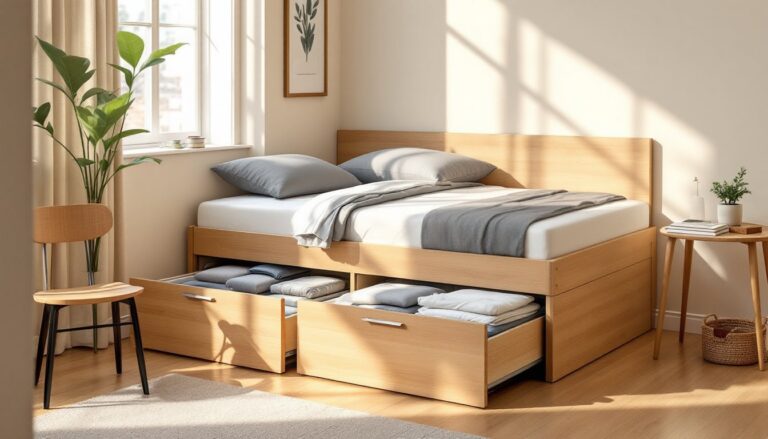
Many pre-made loft beds include integrated dresser drawers, wardrobe cabinets, or pull-out shelves. These units typically feature three to six drawers on roller tracks or soft-close glides, plus a cabinet section with a hanging rod for clothes.
The advantage is instant organization, no need to source separate furniture. The downside is less flexibility. If the drawer layout doesn’t match storage needs (say, too many shallow drawers and not enough deep ones), the user is stuck with it unless they’re willing to modify the frame.
Look for drawers mounted on full-extension ball-bearing slides rather than basic roller tracks. They handle heavier loads and pull out completely, making it easier to reach items in the back. Cabinet doors should use Euro hinges (also called cup hinges) for adjustability: they allow fine-tuning if doors sag over time.
Some designs place storage on one side of the bed, leaving the other side open for a desk or seating. This hybrid approach works well in multipurpose rooms where both wardrobe space and work surface are needed. If someone’s building under bed storage solutions separately, a loft bed with cabinets on just one side allows flexibility on the other.
Shelving and Desk Workstations
Instead of drawers, some loft beds incorporate open shelving, a built-in desk, or a combination of both. A desk underneath the loft creates a dedicated workspace without sacrificing floor area, ideal for students or remote workers in tight quarters.
Desks built into loft frames are typically 42 to 60 inches wide, matching the bed’s footprint. They often include a hutch or overhead shelves for books and supplies. Check the desk’s height: standard desk height is 28 to 30 inches, but some loft-integrated desks sit lower to maximize headroom. If the desk is too short, it’ll feel awkward for typing or writing.
Open shelving offers versatility. Adjustable shelves let users customize spacing for bins, baskets, or folded clothes. But, open storage looks messiest fastest. Without drawer fronts or cabinet doors, everything’s on display, so it demands more discipline to keep tidy.
For DIYers who enjoy furniture building tutorials, adding custom shelving beneath a basic loft frame is straightforward. Use 3/4-inch plywood or MDF for shelves, supported by 1×2 or 1×3 cleats screwed into the loft’s vertical posts. Space shelves 10 to 14 inches apart for folded clothes or storage bins.
Selecting the Right Full Size Loft Bed for Your Space
Measure the room before shopping. A full size loft bed typically needs a footprint of roughly 57 inches wide × 80 inches long (allowing for frame thickness beyond the mattress dimensions). Add clearance on at least one long side, 24 to 30 inches, for ladder access and making the bed.
Ceiling height is the make-or-break factor. Measure from floor to ceiling, then subtract the loft height. Most full-size loft beds place the mattress platform 48 to 60 inches off the ground. Add 8 to 10 inches for mattress thickness, and you need at least 30 inches above that for sitting upright. In an 8-foot room, a 60-inch-high loft leaves just 36 inches of headroom, barely enough. A 48-inch platform is more comfortable.
Material and weight capacity matter, especially for adults. Frames made from solid wood (pine, oak, or birch) or heavy-gauge steel tubing are sturdier than particleboard or thin metal. Check the manufacturer’s weight rating: a quality adult loft bed should support 500 to 800 pounds combined (mattress, sleeper, plus anyone sitting on the bed). Anything rated below 400 pounds is likely intended for children.
Solid wood posts should be at least 3 inches × 3 inches nominal (actual 2.5″ × 2.5″) for adequate strength. Steel tubing should be 14-gauge or thicker. Avoid frames with plastic corner brackets or wobbly joints, those will loosen over time.
Consider ladder placement. Some frames have fixed ladders on the short end: others offer side-mounted or angled ladders. Angled ladders are easier to climb but take up more floor space. Vertical ladders save room but feel steeper, especially at night. A few models include stairs with built-in drawers, trading floor space for convenience and extra storage.
DIY vs. Pre-Made: Which Option Is Best for You?
Pre-made loft beds simplify the process. They arrive as flat-pack kits with pre-drilled holes, hardware, and instructions. Assembly still takes 3 to 6 hours and usually requires two people, but no custom cutting or advanced joinery is involved. Prices range from $400 to $1,500 depending on materials and storage features.
The main drawback is limited customization. Pre-made frames come in fixed dimensions, and storage configurations can’t be altered without voiding warranties or compromising structural integrity. If the room has an awkward layout or non-standard ceiling height, a stock frame might not fit well.
Building a loft bed from scratch offers flexibility but demands woodworking skill. It’s not a beginner project. The frame must support hundreds of pounds, resist racking (side-to-side wobble), and meet basic safety standards. Mistakes can lead to a dangerous structure.
A DIY full-size loft bed typically requires:
- Four vertical posts: 4×4 lumber (actual 3.5″ × 3.5″), cut to desired height
- Side rails and end rails: 2×6 or 2×8 boards for the mattress platform frame
- Slats: 1×4 boards spaced 2 to 3 inches apart to support the mattress
- Fasteners: 3-inch construction screws, carriage bolts, and lag bolts for joints
- Guardrails: 2×4 or 2×6 boards on three sides, at least 5 inches above the mattress top per safety guidelines
Many beginner woodworking projects sites offer free plans, but verify they’re designed for full-size beds and adult weight loads. Twin-size plans won’t scale directly: the longer span of a full mattress requires beefier framing to prevent sagging.
Material costs for a DIY loft run $200 to $400 for basic construction lumber, plus hardware. Hardwood or plywood upgrades increase cost but improve appearance and durability. Budget another $50 to $100 for finish (paint or stain, polyurethane) and sandpaper.
Tools needed: circular saw or miter saw, drill/driver, level, tape measure, speed square, and clamps. A pocket hole jig simplifies joinery. Borrowed or rented tools work fine if this is a one-off project.
Permit note: In most jurisdictions, furniture doesn’t require a permit. But, if the loft bed is anchored to wall studs (recommended for stability), and the project involves altering wall structure, check local codes. Some municipalities treat built-in furniture differently than freestanding pieces.
Installation and Safety Considerations
Whether assembling a kit or building from scratch, follow these guidelines to ensure a safe, stable loft bed.
Anchor to the wall. Most loft beds benefit from being secured to at least one wall. Use 3-inch lag bolts driven into wall studs (not drywall anchors). Locate studs with a stud finder, typically spaced 16 inches on center. Anchoring prevents tipping and reduces side-to-side sway, especially important for taller frames.
Install guardrails on all open sides. Building codes for bunk beds (IRC Section R308) recommend guardrails at least 5 inches above the mattress surface. For adults, higher is better, 7 to 9 inches reduces rollover risk. Leave a gap of 15 inches on one side for the ladder, but rail the rest.
Use quality fasteners. Don’t rely solely on cam-lock hardware or wooden dowels for load-bearing joints. Reinforce critical connections (posts to rails) with carriage bolts or lag screws. Bolts provide a mechanical connection that won’t loosen over time like screws can.
Check the mattress support system. Slats should span no more than 3 to 4 inches apart to prevent sagging and ensure mattress warranty compliance. Some mattresses require a solid platform: check the manufacturer’s specs. If using slats, they should be at least 3/4 inch thick and rest on a center support beam for a full-size bed to prevent bowing.
Mind the ladder. Ladders should be angled or have wide, flat rungs, not round dowels. Round rungs hurt bare feet and are harder to grip. Space rungs 10 to 12 inches apart. If building a custom ladder, use 1×4 lumber for rungs, screwed and glued into the side rails.
PPE during assembly: Wear safety glasses when drilling or cutting, and work gloves when handling lumber to prevent splinters. If sanding or using power saws, a dust mask is essential. Ear protection is recommended for extended use of loud tools.
Test stability before use. Once assembled, push firmly on the frame from multiple angles. It should feel solid with minimal wobble. Climb up and sit on the edge of the mattress platform, if it flexes noticeably, add a center support beam or additional fasteners. Don’t skip this step.