Small bedrooms demand smart furniture choices, and corner bed frames with storage deliver exactly that. These space-saving designs tuck into the often-wasted corner real estate while doubling as storage hubs for linens, off-season clothes, or whatever else needs to disappear from view. Whether someone’s dealing with a cramped city apartment or a kid’s room bursting with toys, a corner bed with built-in storage solves two problems at once: sleeping space and clutter. This guide walks through everything needed to choose, build, or buy the right corner bed frame for any space.
Table of Contents
ToggleKey Takeaways
- A corner bed frame with storage maximizes small bedroom space by utilizing corner real estate while providing 12–30 cubic feet of storage capacity for linens, seasonal clothing, and other items.
- Corner bed frames improve room functionality by freeing up wall space for desks or dressers and enhancing traffic flow, making rooms under 120 square feet feel larger and more navigable.
- Storage options include built-in drawer systems (rated for 75–120 lbs each) ideal for frequently accessed items, and hydraulic lift mechanisms better suited for bulky seasonal gear that requires occasional access.
- When selecting a corner bed frame, measure your corner’s footprint (minimum 6×6 feet for twin size), account for ceiling height, and match the storage type to your actual needs and mobility considerations.
- DIY corner bed frame projects cost $280–$560 in materials and require 16–24 hours of work with intermediate woodworking skills, while pre-made frames ($400–$800) offer faster installation with less customization risk.
- Corner bed frames require wall anchoring if they include tall vertical elements and need safety stays or locking mechanisms on hydraulic systems to prevent accidental closure and injury.
What Is a Corner Bed Frame with Storage?
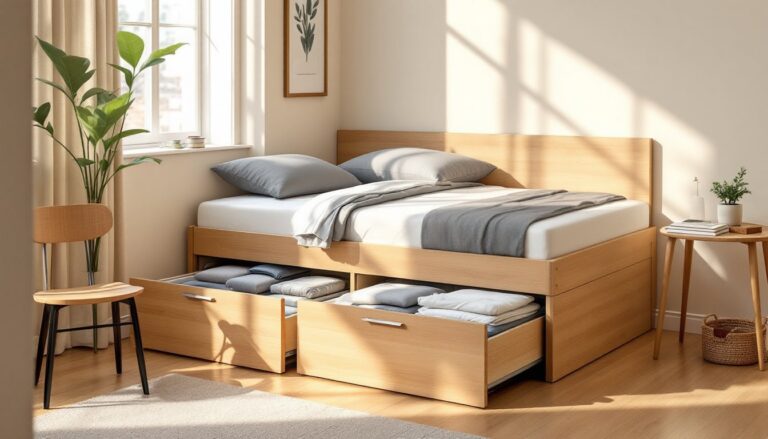
A corner bed frame with storage is exactly what it sounds like: a bed designed to fit into a room’s corner while incorporating storage compartments beneath or around the sleeping surface. Unlike standard beds that float along a wall, corner frames often feature an L-shaped footprint or angled headboard that hugs two perpendicular walls.
The storage component varies widely. Some frames include drawer banks running along one or both exposed sides. Others use hydraulic lift mechanisms that raise the entire mattress platform to reveal a cavernous storage bay underneath. A few designs incorporate shelving units or cubbies built into the headboard or footboard structure.
These frames typically accommodate twin, twin XL, or full-size mattresses, queen and king versions are rare because they consume too much floor space when angled into a corner. The frame itself is usually constructed from plywood, MDF, solid pine, or engineered lumber, with drawer boxes made from 1/2-inch plywood or dovetailed hardwood for durability.
Corner beds shine in shared kids’ rooms, studio apartments, guest rooms, or any space where square footage is at a premium. They’re not load-bearing structures, but they do need to be anchored to wall studs if the design includes tall vertical elements to prevent tipping.
Why Choose a Corner Bed Frame for Your Bedroom?
Corner placement frees up wall space that would otherwise be blocked by a traditional bed. That extra real estate can accommodate a desk, dresser, or reading nook, crucial in rooms under 120 square feet.
The storage capacity rivals a small closet. A twin-size hydraulic lift bed can hold roughly 30 cubic feet of gear, equivalent to about six large storage bins. Drawer-style frames typically offer 12–18 cubic feet spread across three to six compartments, perfect for organizing bedding by type or season.
Corner beds also improve traffic flow. By anchoring the bed in the corner, the center of the room stays open, making the space feel larger and easier to navigate. This matters in kids’ rooms where floor space doubles as play area.
From a design standpoint, corner beds create visual interest. The angled orientation breaks up the boxy feel of small rooms and draws the eye upward if the frame includes vertical shelving or a tall headboard.
One honest drawback: corner beds can be awkward to make. Tucking sheets around the wall-side corners requires either flexible joints or pulling the mattress away from the wall every wash day. Also, if the room layout changes, corner beds don’t adapt as easily as standard frames, they’re purpose-built for that specific orientation.
Types of Storage Options in Corner Bed Frames
Built-In Drawers and Compartments
Drawer systems run on either ball-bearing slides or euro-style undermount tracks. Ball-bearing slides (rated for 75–100 lbs per drawer) are easier to install and cost less, but they’re visible from the side. Undermount tracks hide beneath the drawer box and handle heavier loads, up to 120 lbs, but require precise mounting and add $15–$30 per drawer in hardware costs.
Drawers typically measure 12–18 inches deep, 24–36 inches wide, and 6–10 inches tall. Shallower drawers work well for folded clothes or shoes: deeper ones handle bulkier items like comforters or out-of-season coats.
Some frames substitute open cubbies or fabric bins for traditional drawers. These cost less to build and allow quick access, but they don’t contain dust or hide clutter as effectively. If someone’s building from scratch, cubbies make sense for kids’ rooms where toys need frequent rotation.
Compartmentalized designs, think divided sections within a single large drawer, help keep smaller items like accessories or craft supplies organized. Adding 1/4-inch plywood dividers is a simple upgrade that prevents the junk-drawer effect.
Hydraulic Lift Storage
Gas strut lifts (also called hydraulic or pneumatic lifts) mount along the bed frame’s sides and provide assisted lifting when accessing the storage cavity below. Each strut is rated by Newton force, most bed applications use 800N to 1200N struts depending on mattress weight and platform size.
A twin bed with a 200-lb capacity (mattress plus platform) typically requires two 1000N struts. Full-size frames need either stronger struts or additional mounting points. Struts cost $20–$50 per pair and install with basic hand tools, though proper placement is critical, mount them too close to the hinge and they won’t provide enough lift: too far and they’ll strain the mechanism.
The storage bay in a lift-style bed is one continuous space, roughly 6–12 inches deep depending on frame height. That’s enough for off-season wardrobes, extra bedding, or luggage. Some builders add under bed storage bins inside the cavity to keep contents organized and prevent items from shifting.
One safety note: hydraulic beds need safety stays or locking mechanisms to prevent accidental closure. If a child or pet were underneath when the platform dropped, the result could be serious injury. Most quality kits include stays: DIY builders should budget for them separately.
Lift beds also require more vertical clearance, the frame itself sits 18–24 inches off the floor compared to 12–15 inches for a drawer-style bed. That extra height can make the room feel smaller or create awkward proportions if ceiling height is already limited.
How to Select the Right Corner Bed Frame for Your Space
Start by measuring the corner. Most corner beds need a minimum 6-foot by 6-foot footprint for a twin frame, including clearance for drawers or lift mechanisms. Measure from the corner outward along both walls, accounting for baseboards (usually 3/4 inch) and any outlets or registers that can’t be blocked.
Next, consider ceiling height. If the room has 8-foot ceilings, a bed frame taller than 20 inches (plus a 10-inch mattress) starts to feel oppressive. Rooms with 9-foot or higher ceilings can handle taller frames with integrated shelving or loft-style designs.
Match the storage type to what’s being stored. Drawers suit folded clothes, shoes, and frequently accessed items. Hydraulic lift systems work better for bulky seasonal gear that doesn’t need daily access. If the user is older or has mobility issues, drawers are easier to manage than lifting a mattress.
Check the frame’s weight capacity. Most residential bed frames are rated for 500–800 lbs total, which includes the mattress, sleepers, and any stored items. Cheaper frames made from particleboard or thin MDF may sag over time, especially if drawers are loaded with heavy items.
Inspect the joinery if buying assembled. Frames joined with pocket screws, dowels, or mortise-and-tenon joints outlast those held together with cam locks or plastic brackets. If buying flat-pack furniture, expect to spend 2–4 hours on assembly with a drill, rubber mallet, and patience.
Finally, think about future flexibility. A corner bed locks the room layout into place. If there’s any chance the room will be repurposed or furniture rearranged, a modular system or standard bed frame might be smarter long-term.
DIY Corner Bed Frame with Storage: Is It Worth Building Yourself?
Building a corner bed frame from scratch is doable for intermediate woodworkers but requires more than weekend-warrior skills. The project involves cutting sheet goods to size, assembling drawer boxes, installing slides, and ensuring the frame is square and level, any of which can go sideways without the right tools and prep.
Material costs for a twin-size frame with drawer storage run $200–$400, depending on lumber choice. 3/4-inch plywood or MDF forms the platform and sides: 1×4 pine or poplar works for face frames: and 1/2-inch plywood builds the drawer boxes. Add another $50–$100 for hardware (slides, handles, screws, wood glue) and $30–$60 for finish (paint or stain plus polyurethane).
Tool-wise, a table saw or circular saw with a straightedge guide is essential for breaking down sheet goods. A miter saw handles crosscuts and trim. A drill/driver and pocket hole jig simplify assembly. Drawer slides require precise placement, so a tape measure, combination square, and level are non-negotiable.
Time commitment: plan for 16–24 hours spread over several days. That includes cutting, assembly, sanding, finishing, and installation. First-timers should add 25% more time for mistakes and do-overs.
Pre-made plans save headaches. Resources like Fix This Build That and The Handyman’s Daughter offer detailed cut lists, 3D diagrams, and step-by-step instructions that eliminate guesswork. Free plans exist, but paid versions ($10–$20) often include material optimization to reduce waste and cost.
The biggest DIY advantage is customization. Someone building their own frame can adjust dimensions to fit odd-shaped corners, add extra drawers, or integrate features like USB charging ports or reading lights.
The downside? If the frame isn’t square or the drawers bind, there’s no customer service to call. And resale value is near zero, custom-built furniture rarely recoups material costs if the homeowner moves.
For someone with the tools, skills, and time, DIY makes sense. For everyone else, a mid-range manufactured frame ($400–$800) delivers similar function with less risk and faster turnaround. Either way, the project is manageable, just be honest about skill level before the first cut.